AAII — Phase 2 - MCP Server, Jupyter Notebooks
Public-safe, end-to-end path from Terraform IaC → GitHub OIDC → containerized API deployment, with a local Blazor UI to exercise the API.
Portfolio Snapshot
Phase 2 extends the AAII platform with an AI tooling layer, exposing the deployed inference and semantic search capabilities through MCP (Model Context Protocol), notebooks, and a comparative UI. This phase focuses on LLM-facing interfaces, evaluation workflows, and AI system ergonomics, rather than infrastructure.
What it proves
- Ability to expose AI capabilities as standardized tools for LLM clients (MCP), not just HTTP APIs.
- Practical understanding of when to use direct APIs vs tool-mediated calls.
- Experience designing AI systems that are inspectable, testable, and evaluation-friendly.
- Comfort working across API, tool protocol, UI, and notebook-based analysis layers.
Key components
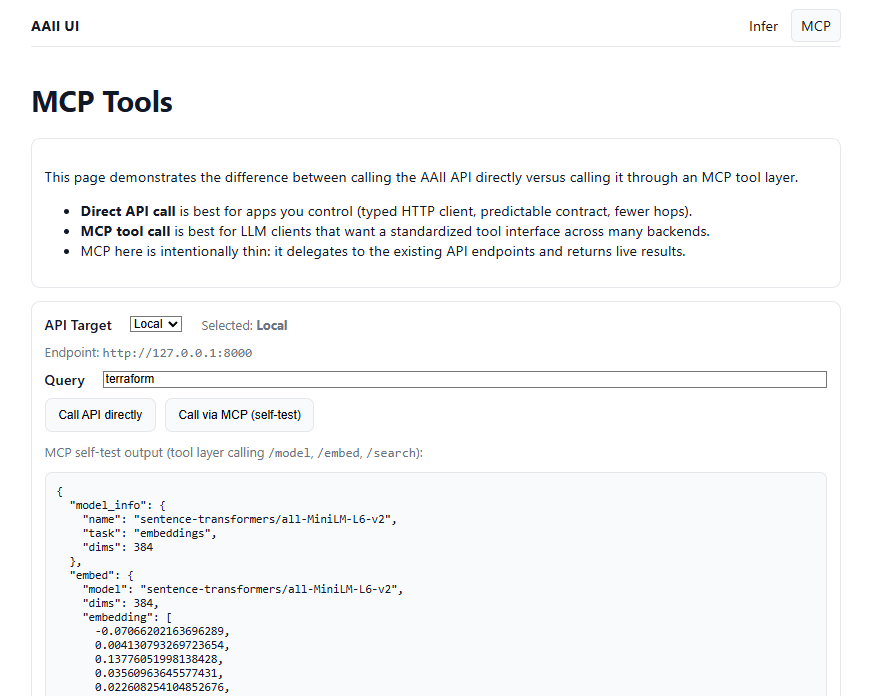
- Minimal MCP server delegating to live AAII API endpoints (/model, /embed, /search).
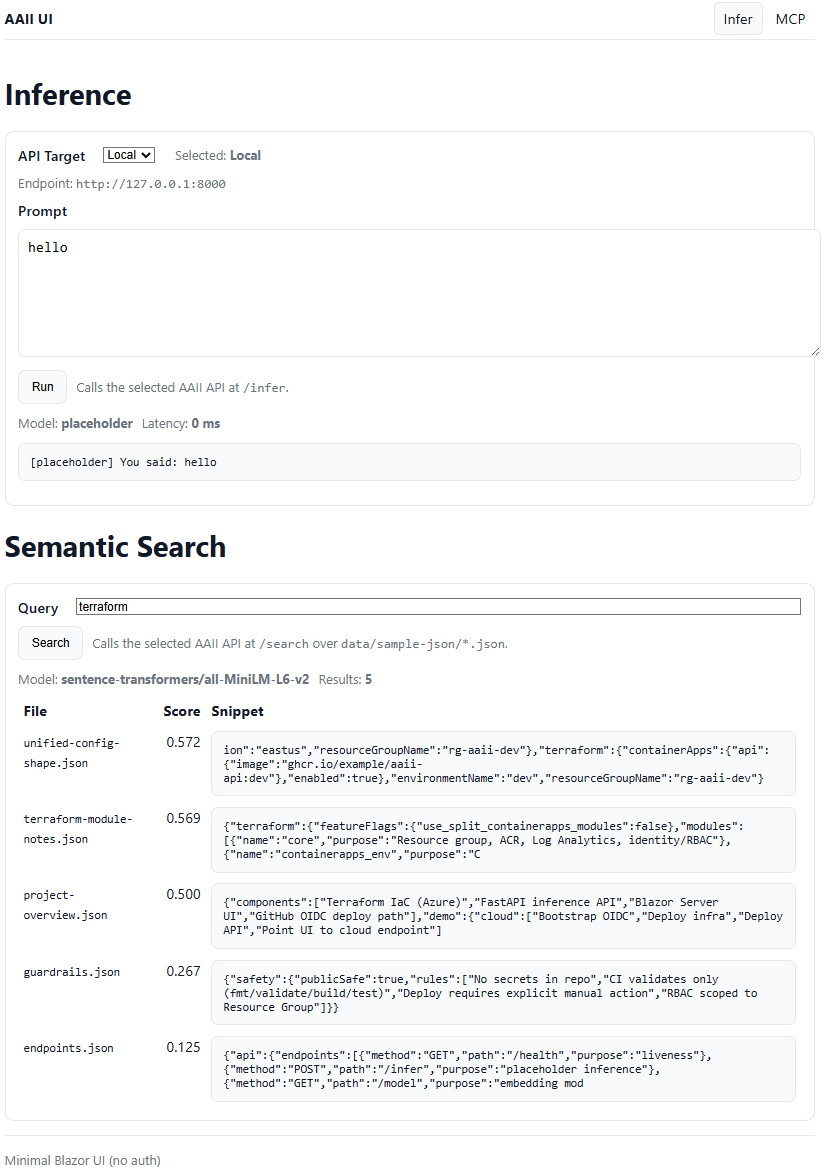
- MCP tool surface for semantic search and embeddings over a real JSON corpus.
- Blazor UI demonstrating side-by-side:
- direct API calls
- MCP tool-layer calls
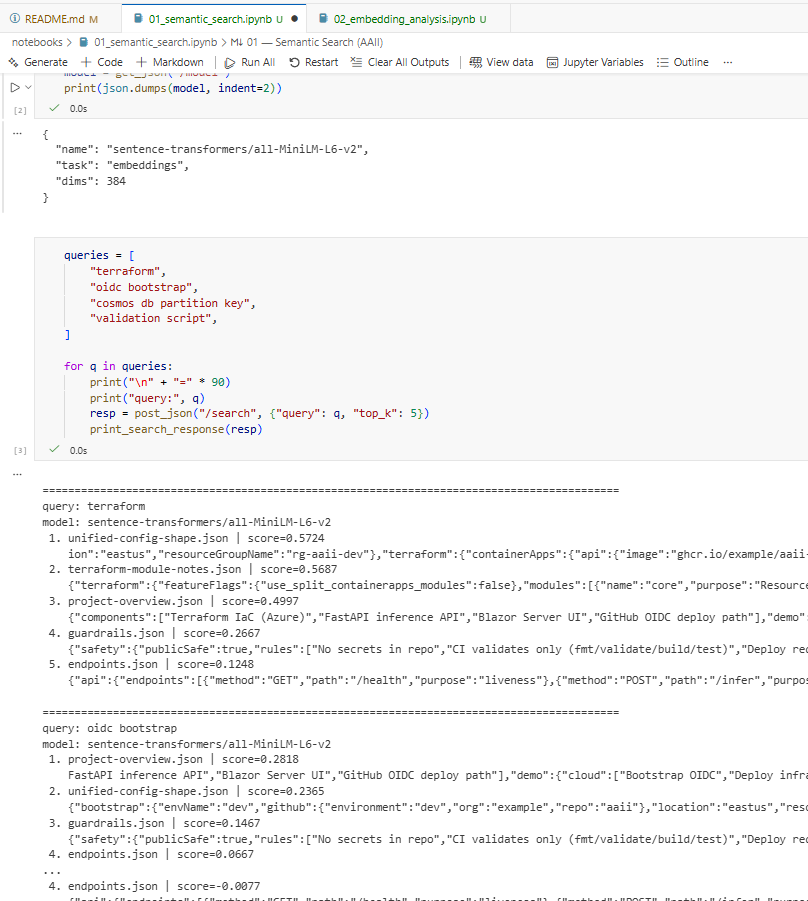
- Jupyter notebooks for:
- embedding inspection and similarity analysis
- semantic search validation and ranking behavior
- CPU-friendly transformer embeddings with deterministic outputs and cached document vectors.
Operational notes
- MCP layer is intentionally thin (no duplicated business logic).
- All tooling runs against the same deployed API used in Phase 1.
- Notebooks and MCP tools are designed for learning, debugging, and evaluation—not production automation.
Verification
Visual evidence of project